# DO NOT EDIT! This file was auto-generated by crates/build/re_types_builder/src/codegen/python/mod.rs
# Based on "crates/store/re_sdk_types/definitions/rerun/blueprint/views/spatial2d.fbs".
from __future__ import annotations
from typing import TYPE_CHECKING
__all__ = ["Spatial2DView"]
from .. import archetypes as blueprint_archetypes, components as blueprint_components
from ..api import View, ViewContentsLike, VisualizerLike
if TYPE_CHECKING:
from collections.abc import Iterable, Mapping, Sequence
from ... import datatypes
from ..._baseclasses import (
AsComponents,
DescribedComponentBatch,
)
from ...datatypes import EntityPathLike, Utf8Like
class Spatial2DView(View):
"""
**View**: For viewing spatial 2D data.
⚠️ **This type is _unstable_ and may change significantly in a way that the data won't be backwards compatible.**
Example
-------
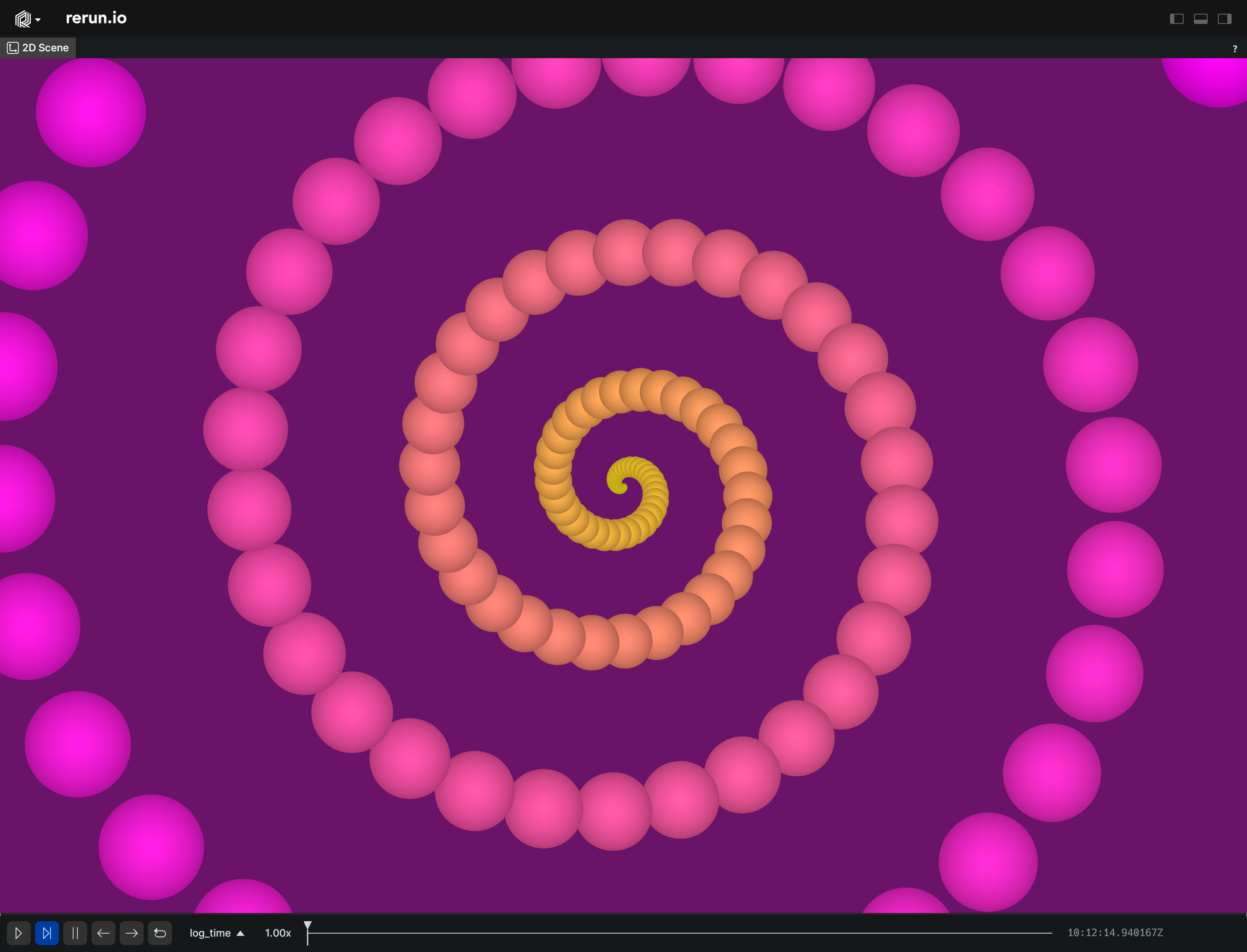
### Use a blueprint to customize a Spatial2DView.:
```python
import numpy as np
import rerun as rr
import rerun.blueprint as rrb
rr.init("rerun_example_spatial_2d", spawn=True)
# Create a spiral of points:
n = 150
angle = np.linspace(0, 10 * np.pi, n)
spiral_radius = np.linspace(0.0, 3.0, n) ** 2
positions = np.column_stack((
np.cos(angle) * spiral_radius,
np.sin(angle) * spiral_radius,
))
colors = np.dstack((
np.linspace(255, 255, n),
np.linspace(255, 0, n),
np.linspace(0, 255, n),
))[0].astype(int)
radii = np.linspace(0.01, 0.7, n)
rr.log("points", rr.Points2D(positions, colors=colors, radii=radii))
# Create a Spatial2D view to display the points.
blueprint = rrb.Blueprint(
rrb.Spatial2DView(
origin="/",
name="2D Scene",
# Set the background color
background=[105, 20, 105],
# Note that this range is smaller than the range of the points,
# so some points will not be visible.
visual_bounds=rrb.VisualBounds2D(x_range=[-5, 5], y_range=[-5, 5]),
),
collapse_panels=True,
)
rr.send_blueprint(blueprint)
```
"""
def __init__(
self,
*,
origin: EntityPathLike = "/",
contents: ViewContentsLike = "$origin/**",
name: Utf8Like | None = None,
visible: datatypes.BoolLike | None = None,
defaults: Iterable[AsComponents | Iterable[DescribedComponentBatch]] | None = None,
overrides: Mapping[EntityPathLike, VisualizerLike | Iterable[VisualizerLike]] | None = None,
background: blueprint_archetypes.Background
| datatypes.Rgba32Like
| blueprint_components.BackgroundKindLike
| None = None,
visual_bounds: blueprint_archetypes.VisualBounds2D | None = None,
time_ranges: blueprint_archetypes.VisibleTimeRanges
| datatypes.VisibleTimeRangeLike
| Sequence[datatypes.VisibleTimeRangeLike]
| None = None,
) -> None:
"""
Construct a blueprint for a new Spatial2DView view.
Parameters
----------
origin:
The `EntityPath` to use as the origin of this view.
All other entities will be transformed to be displayed relative to this origin.
contents:
The contents of the view specified as a query expression.
This is either a single expression, or a list of multiple expressions.
See [rerun.blueprint.archetypes.ViewContents][].
name:
The display name of the view.
visible:
Whether this view is visible.
Defaults to true if not specified.
defaults:
List of archetypes or (described) component batches to add to the view.
When an archetype in the view is missing a component included in this set,
the value of default will be used instead of the normal fallback for the visualizer.
Note that an archetype's required components typically don't have any effect.
It is recommended to use the archetype's `from_fields` method instead and only specify the fields that you need.
overrides:
Dictionary of visualizer overrides to apply to the view. The key is the path to the entity where the override
should be applied. The value is a list of visualizers which should be enabled for that entity, or a single visualizer.
Each visualizer can be configured with arbitrary overrides and mappings.
For any entity mentioned in this map, visualizers are no longer added automatically based on the entity's components.
Important note: the path must be a fully qualified entity path starting at the root. The override paths
do not yet support `$origin` relative paths or glob expressions.
This will be addressed in .
background:
Configuration for the background of the view.
visual_bounds:
The visible parts of the scene, in the coordinate space of the scene.
Everything within these bounds are guaranteed to be visible.
Somethings outside of these bounds may also be visible due to letterboxing.
time_ranges:
Configures which range on each timeline is shown by this view (unless specified differently per entity).
If not specified, the default is to show the latest state of each component.
If a timeline is specified more than once, the first entry will be used.
"""
properties: dict[str, AsComponents] = {}
if background is not None:
if not isinstance(background, blueprint_archetypes.Background):
background = blueprint_archetypes.Background(background)
properties["Background"] = background
if visual_bounds is not None:
if not isinstance(visual_bounds, blueprint_archetypes.VisualBounds2D):
visual_bounds = blueprint_archetypes.VisualBounds2D(visual_bounds)
properties["VisualBounds2D"] = visual_bounds
if time_ranges is not None:
if not isinstance(time_ranges, blueprint_archetypes.VisibleTimeRanges):
time_ranges = blueprint_archetypes.VisibleTimeRanges(time_ranges)
properties["VisibleTimeRanges"] = time_ranges
super().__init__(
class_identifier="2D",
origin=origin,
contents=contents,
name=name,
visible=visible,
properties=properties,
defaults=defaults,
overrides=overrides,
)